Finding A Home: Reconciling the Oppositional Gaze Within A Thousand and One

(Note: Essay contains spoilers)

It is the summer of 1994 and newly released from a stint at New York’s largest and most notorious prison, Rikers Island, convicted thief and hairdresser, Inez de la Paz (Teyana Taylor) returns to the streets of Brooklyn to rescue her six-year-old son, Terry (Aaron Kingsley Adetola), from the same foster care system that raised her. Through a daring act of abduction, Inez steals Terry away from the hospital after his botched attempt to escape the foster facility, and the two flee to the once Black Mecca of America, Harlem, where she will spend the next decade fighting tooth and nail to give him the one thing she never had — a home. In a March 2023 interview on the heels of the wide release of her Black melodrama, A Thousand and One, director A.V. Rockwell sat down with fellow Sundance winner Chinonye Chukwu, the first Black woman to receive the Grand Jury Prize in 2019 with her death row drama Clemency, for an interview with Filmmaker Magazine. Rockwell, a native of New York City, unpacks the challenge of her feature debut, “How do I feel about a city that I love so deeply, but it seems like it doesn’t really love me? This place that’s supposed to be a part of my DNA, how do I reconcile the fact that it doesn’t even want my people here and, looking back through history, probably never has?” In her 1992 essay, “The Oppositional Gaze: Black Female Spectators,” writer and cultural theorist bell hooks, laments a lifelong, unrequited love affair with film, “Mainstream feminist film criticism in no way acknowledges Black female spectatorship. It does not even consider the possibility that women can construct an oppositional gaze via an understanding and awareness of the politics of race and racism” (hooks 123). Through interrogation, hooks takes to task film criticism’s suppression of race while reenacting and mirroring the erasure of Black womanhood that occurs on screen. “Every black woman spectator I talked to, with rare exception, spoke of being ‘on guard’ at the movies” (hooks 126). Thirty years later, Rockwell speaks to this pain as both a spectator and a director, “If they weren’t going to honor us, I wanted to do that in my own way—not just African American women, but underprivileged Black women, especially, because I do think they have the hardest fight.” How does one situate the Black home in an environment that seeks to destabilize all attempts at longevity? The political stakes of Rockwell’s One Thousand and One lay in the recuperation of images of poor Black women on screen as much as in affirming the pleasure of Black women’s spectatorship in a city that harbors nothing by ire for their very existence.

Figure 1. Inez holding six-year-old Terry.

In lieu of dignified depictions of themselves on screen, poor Black women in the United States have had to contend with a prevalence of racist caricatures in film, politics, and news media. During a January 1976 campaign rally, former California governor Ronald Reagan breathed life into the infamous stereotype and boogeywoman of American politics — the welfare queen. “In Chicago, they found a woman who holds the record. She used 80 names, 30 addresses, 15 telephone numbers to collect food stamps, Social Security, veterans’ benefits for four nonexistent deceased veteran husbands, as well as welfare. Her tax-free cash income alone has been running $150,000 a year.” This sensational portrayal became a hallmark of Reagan’s campaign as he would go on to enthusiastically preach the financial evils of women from the South Side of Chicago. Keen observers latched onto the racial dog whistling as the future 40th President of the United States sought to place the nation’s economic strains on the shoulders of low-income women whose greed, according to him, ran so far from the purview of acceptable norms that it had become a crisis on the federal scale. One has to wonder where this rallying spirit was during his term as Commander-in-Chief when Washington’s apathy watched silently as the HIV/AIDs epidemic laid waste to millions of American lives. Twenty years later, Reagan’s Democratic rival and 42nd President, Bill Clinton, signed the Personal Responsibility and Work Opportunity Reconciliation Act of 1996 (P.L. 104-193). The bill was authored by the now 46th President of the United States, Joe Biden, and received resounding bipartisan support. At the signing ceremony, President Clinton proclaimed, “Today, we are ending welfare as we know it…. The two parties cannot attack each other over it. Politicians cannot attack poor people over it. . . . This is not the end of welfare reform, this is the beginning. And we have to all assume responsibility.” His declaration left critics scratching their heads. Many viewed the shift as a convenient scapegoat for economic woes and a means of Democrats demonstrating to their base that they could be just as tough as their Republican counterparts. American writer, attorney, and civil rights activist Michelle Alexander traces the replacement of Aid to Families with Dependent Children (AFDC) with a block grant to states called Temporary Assistance to Needy Families (TANF) in her formative text The New Jim Crow: Mass Incarceration in the Age of Colorblindness. 

“By 1996, the penal budget doubled the amount that had been allocated to AFDC or food stamps. Similarly, funding that had once been used for public housing was being redirected to prison construction. During Clinton’s tenure, Washington slashed funding for public housing by $17 billion (a reduction of 61 percent) and boosted corrections by $19 billion (an increase of 171 percent), effectively making the construction of prisons the nation’s main housing program for the urban poor” (Alexander 57).

Rockwell’s Black female subject exists in the wake of these policy shifts while also finding herself in the political crosshairs of New York City mayors Rudy Guiliani and Michael Bloomberg between 1994 and 2005. Despite their seemingly oppositional visions for revitalizing the city at the dawn of the 21st century, their respective policies enact a united disdain for Inez, Terry, and all native Harlemites. Guiliani’s tenure comes to represent administrative neglect and judicial harassment, while Bloomberg’s tenure signals a mass displacement of natives through gentrification under the ironic banner of progressive inclusion and reform. Early on, struggling to find employment, Inez balks at the suggestion of taking janitorial work in Jamaica Queens as it will require two hours in transit back and forth. She will eventually accept the position but not before Miss Annie (Adriane Lenox), who opens her home to Inez and Terry, chastises her lack of resolve, “Your generation don’t know just how good you have it.” The scene transitions to street-level shots overlaid with audio from then-Mayor Guiliani announcing a crackdown on jaywalking a policy that will disproportionately affect Black and brown residents leading to even higher levels of criminalization for pedestrians. Later on, audio of Mayor Bloomberg’s inaugural address, “As the 108th mayor of the city of New York. As Toni Morrison has said, ‘New York is the last true city.’ And it is the vitality of our neighborhoods that defines us. In the next four years, I will devote myself to building a better New York. Safe, strong, and ready to lead the world in the 21st century. Thank you.” The audio is juxtaposed with footage of corporate outlets— Old Navy, T-Mobile, Chuck E. Cheese, followed immediately by a shot of a nondescript building’s demolition making priorities clear— out with the old, in with the new.

Figure 2. Inez at home in Unit 1001.

If there is to be any doubt about cross-party solidarity, Rockwell shows a devastating moment of thirteen-year-old Terry at the intersection between both administration’s policies when he arrives at the neighborhood laundromat to find the business sold with their doors closed for good. Turning around, he is swarmed by NYPD officers who shove him up against the wall, hands held behind his back, in what is known as a ‘routine stop-and-frisk.’ Once their body search is complete, the officers apologize for assuming Terry to be an adult. At this moment, it becomes clear that his name is no mere coincidence. Terry comes to represent generations of Black individuals stripped of their autonomy, for this sort of warrantless search was once deemed unconstitutional under the Fourth Amendment until the decision of Terry v Ohio in 1968 which ruled that an officer “is entitled for the protection of himself and others in the area to conduct a limited search to discover weapons that might be used against the officer.” Michelle Alexander addresses this judicial shift, “Known as the stop-and-frisk rule, the Terry decision stands for the proposition that, so long as a police officer has ‘reasonable articulable suspicion’ that someone is engaged in criminal activity and dangerous, it is constitutionally permissible to stop, question and frisk him or her— even in the absence of probable cause” (Alexander 63). 

While Rockwell’s narrative portrays an almost seamless transition between mayors, her film’s grammar does much to distinguish the eras through color saturation in line with each mayor’s party affiliation. The Guiliani years are shown in fiery, earthy red tones. The images don’t shy away from the deteriorating architecture, nor the poverty but there is a celebration of the richness and vitality of a community. Around the hour mark as the film jumps to the year 2001 the frame is bathed in dark sapphire blues. Interiors and exteriors become cold and sterile as redevelopment washes over Harlem leaving many houseless. “I wanted to tell a story about a family versus the city. I was trying to understand what happened to New York City as I knew it, and what was happening to communities of color that felt targeted—trying to tell that story but also parallel it against what my experiences have been or experiences other Black women have [had] coming of age in this environment,” said Rockwell of her experience.

At the film’s onset, twenty-two-year-old Inez de la Paz is a difficult woman to love. Her criminal record, her gender and skin tone, along with her houseless status have done much to diminish her character in the eyes of society. During their race to Harlem to evade the reach of social services and law enforcement, Inez stands on a street corner outside a phone booth in the middle of the night desperate to find shelter when she takes Terry’s hands in hers, she promises, “I’ll go to war for you. Do you understand that? Against anybody. Against this whole fucked-up city. They can try all they want. They can try all they want but they not breaking us up this time. You want to find a new home? Hmm?” That night they are offered a brief shelter in the Harlem brownstone owned by Inez’s best friend Kim’s mother, Mrs. Jones (Delissa Reynolds). The surname undoubtedly alludes to “Keeping up with the Joneses,” a popular 20th-century idiom originating in the comic strip of the same name, created by Arthur R. “Pop” Momand in 1913. The phrase was popularized as a marker of socio-economic material success with the obvious burden of stress placed upon those who failed to keep up. Mrs. Jones operates as an emblem of Black respectability, harboring deep suspicion and scorn toward Inez often offering unsolicited criticism. When her daughter’s friend arrives on her doorstep houseless and penniless, she asks if it is ‘Ghetto Inez’ and then refuses to greet them. Later she tells Inez, “You can’t go to anybody’s place looking and talking like that.” Even when Inez can secure work, Mrs. Jones derides her lack of motherly attention telling Terry that when she was little, her mother took the time to teach her to read, implying that her mother had the privilege to spend so much time with her children. This judgment is later corrupted by a scene with Inez reading to Terry but not before tensions become untenable when Inez succumbs to her taunts and becomes physical. The two find themselves houseless once more.

Figure 3. Inez plays with Terry in the park.

In the introduction to Home is Where the Heart Is: Studies in Melodrama and the Woman’s Film, Christine Gledhill states, “Despite the current association of melodrama with the domestic, it could be created out of almost any topic. Nevertheless melodramas invariable deployment of familial values across sub-genres attests to a psychic overdetermination in the conjunction of social and personal, charging the idea of home and family with a symbolic potency” (Gledhill 21). An encouraging declaration no doubt but one wonders how a genre famously dedicated to the predicaments of white, often upwardly mobile women — which rarely finds ruptures wide enough to fit the presence of the Black mammy, in both adaptations of Imitation of Life (1934 & 1959), or a tortured mulatta in John Cassevetes’ Shadows (1959) — will configure itself around the emotional needs of a poor, dark-skinned woman and ex-convict struggling to avoid eviction in an era of gentrification and mass incarceration. Rockwell’s film roots itself in these concerns and they are addressed in the film’s opening sequence when Inez, still incarcerated in Rikers Island, does the hair and make-up of a fellow inmate, also a Black woman. Before she begins Inez must position her subject as Rockwell positions her audience. She tenderly looks over the unnamed Black woman’s hair and face then takes the seat in front of her where their gaze aligns thus signaling a mutual recognition of humanity in both women. Rockwell communicates directly with her Black female spectators— hold your head up high. This is a reaffirming gaze where your stories are handled with the dignity and complexity they deserve. Later, this is further conveyed in Harlem with the reaction of a Black woman from the neighborhood admiring herself in the mirror once Inez finishes her hair. Almost at a loss for words, she remarks “Girl, I feel like something.” Rockwell cultivates an environment where Black women, particularly those of low income, are treated with grace and afforded the space for their humanity to be acknowledged and to see themselves the way they want to be seen.

Rockwell’s film delves into the charged atmosphere of the Black home and Inez’s undying efforts to shield her family from the forces of white supremacist domination seeping in. She is unfettered by traditional markers and constraints of motherhood– blood, money, and legality. When her partner and former partner in crime, Lucky (William Catlett), fresh from a stint in prison asks her, “What do two crooks know about raising a family?” she replies, “Do you remember what it felt like to grow up without a father? I just want us to be a family.” In her essay, ‘Homeplace: A Site of Resistance’ bell hooks lends a critical recognition to much of the radical and unrecognized labor of Black mothers,

“Since sexism delegates to females the task of creating and sustaining a home environment, it has been primarily the responsibility of black women to construct domestic households as spaces of care and nurturance in the face of the brutal harsh reality of racist oppression, of sexist domination. Historically, African-American people believed that the construction of a homeplace, however fragile and tenuous (the slave hut, the wooden shack), had a radical political dimension. Despite the brutal reality of racial apartheid, of domination, one’s homeplace was the one site where one could freely confront the issue of humanization, where one could resist. Black women resisted by making homes where all black people could strive to be subjects, not objects, where we could be affirmed in our minds and hearts despite poverty, hardship, and deprivation, where we could restore to ourselves the dignity denied us on the outside in the public world.” (hooks 42)

Throughout the film, Inez is shown between work shifts, contributing a titanic amount of love into Unit 1001— from new coats of paint for his bedroom to taping Terry’s artwork on the wall, to nightly home-cooked meals, to purchasing books for Terry to read. She procures a counterfeit social security card for his doctor’s visits and later on prods him to apply for a specialty high school that will open him up to opportunities she never had. Unfortunately though not surprisingly, her sacrifices will go largely unacknowledged. Lucky becomes an on-again, off-again presence in her life, disappearing on a whim for months at a time when life at home becomes overwhelming. Coming of age for most of the film, Terry struggles to see his mother beyond his domestic expectations.

Class status will act as a constant divider throughout the film separating even Black women from each other. Mrs. Jones is none too thrilled with the prospect of hosting an ex-convict and single mother. As tensions flair, she walks away from an argument with Inez, telling her, “I don’t think anything of you,” before commenting that their presence is, “Turning my house into damn 125th Street.” Her daughter Kim (Terri Abney), the only friend Inez can turn to in her time of need, takes a softer approach though her line of inquiry speaks to a naivety to circumstance. As the two lay in her bed, Kim asks Inez if she was able to earn her GED. When Inez confirms that she obtained her degree while in prison, Kim enthusiastically cheers for her spurring a less than gracious response from Inez who tells her, “You always get excited about the weirdest things.” While this response can be attributed to Inez’s prickly demeanor, the boundaries surrounding her circumstance are made clear a moment later when Inez laments the lack of employment opportunities for hairstylists in Harlem and Kim flippantly suggests that Inez simply open her own shop as though it would manifest at the snap of her fingers. Inez asks her what she is supposed to do about money at that very moment, stating her immediate needs— food and shelter. Her limitations are further heightened by the police sirens playing in the background throughout their exchange. The film later introduces Mrs. Tucker, a light-skinned Black female social worker, whose repeated claims of working in Terry’s best interests are rendered dubious as she requires his cooperation with the same law enforcement apparatus that has demonstrated its antagonistic stance toward him and Inez for years. The accumulated weight of all that these women do not see in a poor, dark-skinned single mother with a criminal record amounts to the crux of the film’s contentions. During their confrontation, Inez tells Terry, “Nobody else give a shit about Black women except for other Black women, and even that shit get messy.”

Citing her early essay ‘Do you remember Saphire?’ hooks recounts her experience with onscreen negations of Black female representation, the shame and displeasure, and the turning away,  

“She was even then backdrop, foil. She was bitch-nag. She was there to soften images of Black men, to make them seem vulnerable, easygoing, funny; and unthreatening to a white audience. She was there as man in drag, as castrating bitch, as someone to be lied to, someone to be tricked, someone the white and Black audience could hate. Scapegoated on all sides… We did not long for her. We did not want our construction to be this hated black female thing-foil, backdrop. Her black female image was not the body of desire. There was nothing to see. She was not us” (hooks 120).

The proliferation of images of the hardened, desexualized, and undesirable overbearing Black women saturate 20th-century American cinema while showing no signs of letting up in the 21st. From Tyler Perry’s long-running Madea franchise spanning over a dozen films to retro and contemporary mammy renditions in Precious (2009), The Help (2011), and The Butler (2013), to popular depictions of literal drag in the films of Eddie Murphy and Martin Lawrence such as Norbit (2007) and Big Momma’s House (2000) and Big Momma’s House 2 (2006), Black female spectators still contend with delegitimizing images of themselves. Rockwell says of her film, “What people that see the film understand by the end is that this was a story about a Black woman who was desperate to be loved, not just needed.”

While Rockwell demonstrates her ease at endowing her Black female subjects with care, Inez will spend the entirety of the film fighting for scraps of empathy from her son, her husband Lucky (William Catlett), her neighbors, landlords, and city hall. During an argument with her on-again, off-again partner Lucky, Inez speaks to this erasure,

Inez: Who gives a fuck about what [Terry/Darryl] wants? What does he need?

Lucky: You’re too tough. Maybe if you quiet down some, he would actually hear what you have to say.

Inez: I don’t even remember the last time I raised my voice. You used to like when I got spicy. [Taunts] You should try and be quiet. If I get any quieter I won’t have a fuckin’ voice at all… You get to be the saint while I’m stuck here fighting these wars all by myself.

Lucky: See how loud you’re getting?

Inez: Show up for me! I wonder what would happen if I leave too.

Rockwell is not content with merely presenting her subject as an innocent, put-upon victim and source of sentimentality for audiences to offer sympathy and little more. Over time, Inez is forced to look inward at her pattern of behavior and more importantly, why she feels she must keep up such a “strong” front. Alone again after her fight with Lucky, Inez dines on a cup of instant noodles with nothing but the glow of the television to light her space, signaling a lack of time and energy to look after herself once she has looked after everyone else. In another moment of onscreen spectatorship, the camera holds an extended close-up shot of Inez’s face as the audio from an episode of Ricki Lake’s talk show plays in the background. The segment features a Black couple talking through their issues and compromise. We hear an echo of Inez on stage in a Black woman who talks about losing friendship, saying, “Well, it has cost me a lot of friendships, and a lot of relationships, but I find in life that having a friend in yourself is better than worrying about having people as your friends, ‘cause no one’s gonna look out for you but you, and I’ve learned that in life. [audience applause] I’ve looked out for people you know, but– I mean, I’m saying, I have friends now. They’re bitchy like me, so we get along. I’m serious. We understand each other. And I help out with some of my family members as well as they help me.” Throughout this exchange, Inez’s expressions shift from tears to laughter to tears again as she sees herself in this woman and feels seen.

Figure 4. Goodbye for now.

A driving force throughout A Thousand and One is the recuperation of the past. Being a product of the New York state foster system, Inez vows with all her might to keep Terry from the harm she incurred as a youth. In a news report, his shelter is referred to as “One of the city’s most troubled and underfunded hospitals.” Her motivations lay in providing Terry with a home, a family, and two loving parents. Unit 1001 becomes their home for a period, the stability of the marriage waxes and wanes, and eventually Terry must spread his wings out into the big world but through it all Inez remains as determined as when she began. Christine Gledhill identifies this melodramatic desire in her introduction, “This surfaces in a persistently nostalgic vein. As David Grimstead and Martha Vicinus note, melodrama’s challenge lies not in confronting how things are, but rather in asserting how they ought to be. But since it operates within the frameworks of the present social order, melodrama conceives ‘the promise of human life’” (Gledhill 21). It is accurate to say Rockwell’s film is as concerned with its present as its past, to such a degree that a tradition of displacement, loss, and longing is formed by the ending. On the eve of his high school graduation, social services uncover Terry/Darryl’s falsified birth certificate. The social worker Ms. Tucker (Amelia Workman)  not only brings the police to their apartment but outs Inez as not Terry’s biological mother expressing false and cruel remorse, “I’m sorry you had to find out like this. I just want what’s best for you.” They tell him they have to remove him from her custody adding, “If that’s alright with you.” Catching Inez on the eve of her flight from law enforcement, Terry confronts her with this information only to learn that it was Inez who took him in after he was abandoned on a street corner at the age of two by his biological mother. He is thrown into a state of total dissolution as the news comes on the heels of Lucky’s passing from cancer and the revelation that before his death, Lucky fathered a child with another woman from the neighborhood behind Inez’s back. Unable to grapple with their impending separation, Inez’s deception, and what comes next, Terry retreats into the past, breaking down into tears and pleading, “‘Cause I’m scared. I’m scared that I won’t have no home no more. And one day I’m gonna show up and it’s gonna feel like we ain’t’ never happened. Ma! Like this wasn’t our living room, our home. I miss my bed, Ma. The one that you made for me. Where is home for me now?”

Ultimately, Rockwell’s film asks spectators irrespective of race how much empathy and grace they are willing to extend to a poor Black female ex-convict. How much of this woman are audiences willing to see? And should spectators find that humanity in Inez, how does one configure what is right and wrong? For Black women who see themselves in Inez, Rockwell imbues her subject with layers of contradiction, compassion, and a degree of existential autonomy rarely seen on screen. “Black female critical thinkers concerned with creating space for the construction of radical Black female subjectivity, and the way cultural production informs this possibility, fully acknowledge the importance of mass media, film in particular, as a powerful site for critical intervention” (hooks 128). The withholding of crucial information until the ending revelation that Inez is not Terry’s biological mother serves as a metaphor for the missing pieces, delegitimized through state violence and government policy, which obstructs a comprehensive picture. What judgment audiences are willing to levy against Inez throughout the film speaks as much to their assumptions as to her character. Capitulation to social and legal norms would have doomed Terry to a motherless childhood within a foster system famous for its neglect. According to New York’s legal framework, as seen through the actions taken by social workers like Ms. Tucker, this would be the only viable path for a boy like Terry. Motherhood is then reduced to a birth certificate and a DNA test— i.e. traditional, lawful heteronormativity. Audiences are left pondering the staggering losses under this framework.

Bibliography

  • Alexander, Michelle. The New Jim Crow: Mass Incarceration in the Age of Colorblindness. New York, The New Press, 2012, Pg. 57-63.
  • Gledhill, Christine. Home is Where the Heart Is: Studies in Melodrama and Women’s Film. London, BFI Publishing, 1987, Pg. 21.
  • hooks, bell. “The Oppositional Gaze: Black Female Spectators.” Black Looks: Race and Representation. Boston, New End Press, 1992, Pgs. 115-132.
  • hooks, bell. “Homeplace: A Site of Resistance.” Yearning: Race, Gender, and Cultural Politics. Routledge, New York, 2015. Pg. 41-49.
Figure 5. A.V. Rockwell and cast.

Remembering Akira Toriyama: The Man Who Got Us Into Anime

Flashback to an early spring afternoon in 1999. Fresh off the middle school bus home, my parents are still working, and I’ve got the house, and more importantly, the TV to myself. Turn on Cartoon Network, my home for Thundercats and Dexter’s Laboratory, to find something new– Toonami’s afternoon block. For months, my best friend Terrell had been bugging me to give this show called Dragon Ball Z a chance. To my luck, there was a mini-marathon that day, a four-episode block, and it had just started. I settled into a spot on the couch completely unaware of the spectacle I was about to witness. Krillin, Gohan, and this fellow with an abnormally large forehead named Vegeta were duking it out with a colorful band of space thugs by the name of the Ginyu Force. Then he showed up. Goku was as radical as an animated hero as I’d ever seen. The spiky hair, the iconic orange gee, his coolness under pressure. It’s impossible to deny the thrill of watching Toriyama’s bodies in motion. The way they flip and dart around, defying gravity, and projecting beams of pure energy from their hands. It struck a desire deep inside of me. The only way to explain is to say it was like finding something you knew were born to find. It opened the door to an entire medium of possibilities. While I was a fan of Western animated series like X-Men and Spider-Man: The Animated Series, they seemed incapable of reaching the heights the art form demanded. Perhaps it was because Dragon Ball, its peers, and its inspirations actively dealt with mature subjects like death and absent parents, and didn’t condescend to the youth it was geared toward. No shade, anime just blew Western animation out of the water. I never would’ve known any of this without Dragon Ball Z.
The news came last night of the passing of Legendary Mangaka, Akira Toriyama. We have lost a titan of animation who single-handedly got the outside world into anime. I mention my introduction to Toriyama because, over the past twenty-five years, I have heard a thousand variations of my story from fans of Dragon Ball around the world on YouTube, at conventions, at film screenings, you name it. I’ve recited the Toonami promos ad infinitum with friends and quoted the dub whenever I need a laugh. Not only am I eternally grateful for Toriyama’s artwork, but I couldn’t be happier to have come up at this very special moment when the rest of the world was waking up to anime. All I have is gratitude. So long!

The first piece of anime I ever bought. Scooped it at Suncoast Video in the mall. Yes, I’m that old.

Literary Report: Dan Sinykin’s Big Fiction (2023)

Part One: Summary

Dan Sinykin’s Big Fiction assumes the mammoth task of charting the progressions of the publishing industry throughout the middle and later decades of the 20th century and how this coalesced into the consolidation of the major publishing houses of the 21st century, into what has been dubbed the Big Five– Penguin Random House, Hachette, HarperCollins, Macmillan, and Simon & Schuster. Big Fiction divides itself into a before-and-after through the sacking of André Schiffrin whose storied career with Pantheon ended in 1990 after nearly three decades with the company his father co-founded. Sinykin uses the moment to mark this as the end of the post-WW2 “flush years” when much of today’s popular conception of the industry highs and lows came to fruition– the dawn of the Man Booker Prize, the National Book Award, while the film adaptations of Michael Crichton, John Grisham, and Stephen King’s works hit the big screen. Sinykin shows us how none of these were organic movements within the industry but rather conscious aims to craft a new American literary market. At once, there is both an attempt to consolidate and expand. He stops short of arguing for or against conglomeration in favor of examining the hurdles and possibilities still inherent to the industry and how certain authors navigate the big houses, as well as, alternatives through non-profits and small independent publishers. “In the 1970s the boom bled into a downturn, and the book business slowed. Wages stagnated and inflation grew, hollowing out the middle class. Conglomeration intervened, creating a class of mega-booksellers” (Sinykin 27). Readers must square this with notions from the end of the century like, “As a panelist at the conference of the American Association of University Professors, Scott Walker predicted, ‘More and more serious books won’t be published by the big commercial houses– their publication will fall to university presses and independent publishers, for whom the 1990s will be a time of tremendous opportunity’” (Sinykin 138).

Sinykin’s main assessment is that there is a great deal of irony at play within an industry that for all its sterile, corporate trappings appears more like a living, breathing organism. The economic downturn in the late 20th century left a void for conglomeration to capture which in turn gave us the likes of B. Dalton, Waldenbooks, Barnes & Noble, and Borders. They cultivated generations of new readers along with an explosion of non-literary books, which in turn, led to further consolidation and downturn in the era of Amazon Books. These shifts seem to be dialectic. Take, for example, the 1984 sale of Waldenbooks to then-nationwide retailer, Kmart. With the prevalence of book sections in today’s Walmarts and Targets this may seem obvious in hindsight but Sinykin shows how this savvy play guided by men like Harry Hoffman would broaden the market to include less literary fiction in favor of “trimming backlist holdings and focusing on new, exciting frontlist titles– cookbooks and celebrity memoirs” (Sinykin 64-65). Hoffman said of the shift, “I don’t think publishers are taking into account that time is a factor. People want something short that they can read in a night” (Sinykin 65) Playing to this perceived shift in readership came the dawn of middlebrow fiction, “the expression of the publishing industry’s technocratic democracy, a product of conglomerate desire, but, unlike formulaic genre fiction, it masks it’s ‘machine-tooled uniformity.’ Think of John Irving, Anita Shreve, Anne Tyler, and Barbara Kingsolver” (Sinykin 67). It cannot be overstated how many new readers were brought into the fold by expanding book vendors into the giants of American commerce and by offering accessible reading to the masses. This laid the groundwork for the massive sales of series like Harry Potter, Twilight, Hunger Games, and 50 Shades of Gray. For the first time in recent, or even past memory, the public has seen the prevalence of overnight, around the building, lines at retailers to buy new fiction releases from each of these series. They produced new readers by the millions. The rise in middlebrow and its ethos around quick and easily digestible stories have paved the way for the prevalence of the audiobook model and subscription programs such as Audible which scholar Sheri-Marie Harrison writes, “are in the technological vanguard of contemporary grind culture– helping you get your edification on while you work out, or do laundry, or drive to pick up your laundry after you work out. It is an art form for the ‘I’ll sleep when I’m dead’ age, allowing us to optimize every transitional moment into a productive one of learning, entertainment, or both” (Sinykin 215) Before readers can jump a definitively cynical conclusion about the seemingly decreasing active participation in literature, he quotes Harrison also stating that while listening to Toni Morrison’s narration of her work in the audio format, “adds an entirely different kind of conspiratorial intimacy” (Sinykin 215). Ultimately, Sinykin leaves it to the reader to assess the tea leaves and decide for themselves what these shifts mean for the present and the future.

Part Two: Assessment

Wrapping up Big Fiction, I am left with the impression that above all else, today there is more. More books are being published today than at any other point in human history. While at the same time, more is expected of the writer than ever before. T.S. Elliot had a fraction of today’s competition but never had to contend with brand management on Instagram and a questionable tweet he may have forgotten he posted a decade prior. While I can make subjective judgments on the quality of what is available on best-seller lists this would be to miss the point. More ultimately means more opportunities for ideas, for writers, and readers. As a black writer in the 21st century, these are the cards we’ve been dealt. I’m keenly aware of the inadvertent opportunities that appeared with the dawn of conglomeration and how a century prior it would have been next to impossible, and in many states near illegal, for me to publish my work.

Sinykin speaks on conglomeration’s relationship to diversity, both through championing the mainstream successes of writers of color such as Maxine Hong Kingston, Toni Morrison, and Amy Tan, as well as through demographic data. He demonstrates how openings appear from time to time for select author within conglomerate publishing but also how the numbers appear bleak in comparison to their nonprofit competitors. “Collectively, 70 percent of these nonprofit authors are white. About 93 percent of Random House authors across the same timespan are white. Moreover, white men account for more than half of authors at Random House, but makeup less than a third at the nonprofits” (Sinykin 152). Again, riding the wave and crest of the flush years, conglomeration has brought with it a mass market like never before with scores of new readers but with a narrowing of desires to fit specific tastes. Andre Schiffrin called the result of this shift “intellectual redlining,” a nod to 20th-century racist housing practices. It must be acknowledged that for every Toni Morrison, there were likely legions of unrecognized talent from marginalized voices that were never considered. Morrison herself remarked on literary writers of color in the ranks of conglomerates at the end of her career as an editor, stating that the market “can only receive one or two” (Sinykin 183). Sinykin hammers this home in his chapter on independents stating, “Conglomerates rarely publish writers of color, especially black men. There’s a resistance on the part of the culture at large to deal with the realities of black life” (Sinykin 187).

Continuing in its dialectical progressions, conglomeration’s specificity and its extremely high threshold to cross for writers of color has created an opening for the nonprofit industry to cultivate niche markets for these underserved writers. “The fiction lists of Coffee House, Graywolf, and Milkweed are more diverse than those of the conglomerates in terms of race and gender” (Sinykin 152). Through Percival Everett’s relationship with Graywolf and the extensively varied subject matter of his long catalog, Sinyin explores the benefits for writers of color, particularly black men. Everett states in a letter to the publication, “What you and Graywolf have done is allowed me the freedom to write as an artist. To my mind, there is nothing more politically significant than for a press to actually free itself, and therefore the artists it shelters, from the noxious political traps this culture lays for its ‘writers of color’” (Sinykin 157). Lest we get too excited, Sinykin notes how nonprofits published writers of color who, “inevitably understood the game they were playing, in which, by way of the nonprofits, they served establishment multiculturalism, and they often expressed their recognition and distaste through their writing, building in critiques of their usefulness to white liberals” (Sinykin 182-183). Norton publishing further wedges this door opens welcoming in misfits such as Walter Mosley who wrote literary genre fiction like the adapted novel Devil in a Blue Dress.

As a black-American reader and writer, I must assess Schiffrin’s neutrality from this standpoint. I find myself among the numerous marginalized backgrounds that have traditionally found limited openings within an industry overwhelmingly dominated by white, and often male, writers. More opportunities, however marginal the gains, represent an opening for writers and readers such as myself to create new footholds in the industry much like the illustrious career of Toni Morrison, because as they say, a rising tide lifts all boats.

Bibliography

Sinykin, Dan. Big Fiction: How Conglomeration Changed the Publishing Industry and American Literature. Columbia University Press, 2023.

Black Cops on Screen: When It’s Not A Mess

Oh, the many, many portrayals we have of black police officers from the black beat cop to the black commissioner. From Mod Squad to Law & Order‘s three-decade run across 65 seasons, In The Heat Of The Night (1967) to Bad Boys III (2020), they are nothing new to our eyes. The question is, why are we seeing more and more of this hyper-specific form of representation in the wake of so many high-profile cases of police brutality and corruption? Why does it feel like black folks have become the face of American law enforcement and the military on screen? The Obama years ushered in the intoxicating fantasy of a post-racial America where interracial couples appear in auto insurance commercials and Kendrick Lamar gets invited to the White House for a 4th of July barbeque. It was the era when many of us got our first smartphone and Brooklyn 99 started its eight-season run. You might not think these events were fundamentally at odds, especially considering the Obama campaign’s ability to utilize social media effectively to win elections, but they were. While mainstream America patted itself on the back for electing its first non-white male president, a critical mass of police brutality footage caught on iPhones and Galaxy+ cameras began appearing with increasing frequency across social media. Black folks oscillated between images of gilded White House galas awash with black celebrities and artists celebrating Black excellence to videos of the state-sanctioned murder of our people in broad daylight. One reality seemed to negate the other. Was America becoming the dream it always promised us or was it finally being seen for what it really is? Donald Trump’s ascendancy became the answer to this question.

These days it seems audiences are swimming in black copaganda while our president, carried into office on the back of the BLM movement’s 2020 voter registration campaign, calls for even greater funding of the police. We’re not just the good apples on screen either, we’re the nasty and the incompetent ones too. We’re all the parts of the basket that you can see. The deluge is meant to placate us. For every black face in authority, for better or worse we are to ask ourselves, is this really something you want to tear down? And yet there is such a drought of film and television that speaks to the racial realities of being a black police officer. In this piece, I will highlight two films that go against the copaganda grain in their unflinching portrayals of what it means to be black in law enforcement. Christopher St. John’s Top of the Heap (1972) and Bill Duke’s Deep Cover (1992).

Before we go any further it will be useful to provide a quick definition of copaganda for readers unfamiliar with the term. Mark Anthony Neal outlines the term and its function in his piece, “Copaganda: How pop culture helped turn police officers into Rock Stars — and Black Folks into Criminals,” which is a great read that I recommend:

“Copaganda — the reproduction and circulation in mainstream media of propaganda that is favorable to law enforcement — has long been a tool to disrupt legitimate claims of anti-Black violence. Simply put, copaganda actively counters attempts to hold police malfeasance accountable by reinforcing the ideas that the police are generally fair and hardworking, and that “Black criminals” deserve the brutal treatment they receive. Such cultural framing has been critical to buttressing the need for a more expansive criminal justice system that fuels mass incarceration.”

TOP OF THE HEAP (1972)
Dir. Christopher St. John
Streaming: Plex, Tubi, Amazon

Continually passed over for promotion, loathed by his community, and resented by his family, D.C. Officer George Lattimer is a pulsating ball of rage ready to unload on any petty offender in his path. Living in financial constraints and watching the years pass him by, George is trapped between the badge and his people. He is painfully aware of the department’s racism, that no matter how many exams he takes, no matter how many hours of overtime he puts in, he’ll never advance. But back out on the street, he is reminded at every turn that the shield is often the only thing standing between him and the bitter ire of post-civil rights era white America.

Top of the Heap doesn’t mince words and the story has no attachment to whatever supposed valor there is for black officers. George acts as a willing weapon for a racist state. He is hardworking but untrustworthy, strong but cruel. He’s the sort that’s more likely to kick a door in than walk cooly into a room. He offers no down-home wisdom and he has no catchphrases. The man is real uptight. Paula Kelly, his unnamed side-piece, tells him he ought to loosen up and get his head right but even an orgasm can’t relax him. At the heart of the story is George’s mother’s passing and his inability to grieve, to let his guard down for even a second.

There is so much emptiness in George’s pursuit of meaning and prestige on the police force. When he reaches the point of emotional and spiritual despair and tells his wife he wants to quit the force, he finds little sympathy in his wife who reminds him that he is supporting a family and does not have the luxury of changing careers. There is no Hollywood reprieve to be found, and no sudden opportunities emerge. This is a profoundly sad film. I cried on both watches. NASA becomes an allegory for serving, as a wish for escape, as a fear of total isolation. The moonbeams in his spacy visions harken Curtis Mayfield’s premonition on Freddie’s Dead, “We can deal with rockets and dreams / But reality / What does it mean?” Nothing tops his dance with his mother though. I melted.

DEEP COVER (1992)
Dir. Bill Duke
Streaming: Rentable on Apple and Amazon

We open with tragedy as young Russell Stevens watches his junkie father gunned down on Christmas Eve after a robbery gone awry. Traumatized, he swears he will never let this happen to him. Born poor and black, Stevens is yet unaware he was lost at birth. Flash a couple decades ahead and we find him behind a badge working for the Cincinnati Police Department. When asked why he became a cop, he says, “Because I wanted to be of some use…to make a difference somehow.” The first shot inside the station opens with a racist question from DEA Special Agent Gerald Carver that serves as the answer to everything we need to know about how the organization moves. The question stuns and disqualifies the first two black officers but not Stevens. We learn that his psychological profile scores “almost exactly like a criminal. Resents authority. Rigid moral code…but with no underlying system of values.” Thus, he is recruited to go undercover in Los Angeles. For how long? “Six months, a year, five years,” Carver waffles without clarity.

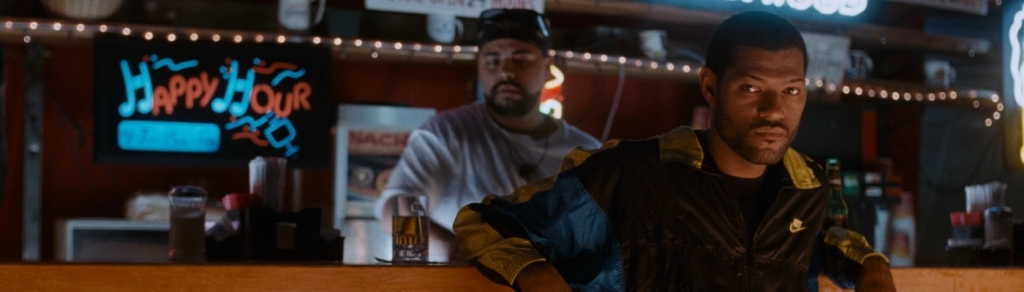
Fresh off the set of Boyz N the Hood (1991), Lawrence Fishburne steps away from the enlightened consciousness of Jason “Furious” Styles Jr. into the angry uncertainties of Russell Stevens (John Hull) without Fishburne sacrificing any of his inherent cool. In the street, the divisions in his psyche profile play out. While attempting to get closure to a seller he witnessed the murder of a young boy selling on the corner and reports this to Carver who seems sincerely puzzled by Stevens’ morals and brushes the event off. The longer he stays under, the more he sees, and the more he sees, the more he loses grip of his sanity. All he wants is to bring the investigation to its conclusion, to bag the seller at the top, and come back into the fold. But was stopping the flow of drugs in the community ever really his assignment?

In my rewatch, I was struck by Duke’s ability to weave in a real-life geopolitical context. The further down the rabbit hole we go, the more the United States federal and state law enforcement becomes undeniably complicit in the crack boom. The DEA is sponsoring the flow of cocaine out of Central America into low-income black communities in southern California to fund the right-wing contras rebelling against the Sandinista Revolution 1978-79 in Nicaragua.

Stevens: What is he, the new Noriega? He helps you fight communists, you Iet him bring in drugs to sell it to niggers and spics, and you use me to do that shit?

Carver: You violated orders! Don’t make a conspiracy of it!

Stevens is trapped between a superior officer who boasts of himself as God, pressuring him to lose himself in his undercover persona, and a black LA detective steeped in Christian moralism who equates selling drugs to putting a loaded gun to someone’s head. Neither can have his best interests in mind. We leave Stevens just as complicated as we found him. His true allegiance is left muddled and his sense of self is fractured, perhaps indefinitely. We are left with a question:

“We took eleven million in drug profits out of the van. The money doesn’t know where it comes from, but I do. If I keep it, I’m a criminal. If I give it to the government, I’m a fool. If I try and do some good with it, maybe it just makes things worse. Either way, I’ll probably just wind up getting myself in more trouble. It’s an impossible choice, but in a way, we all have to make it. What would you do?”

Wrap-Up

In Charles Burnett’s short film Quiet As Kept (2007), a New Orleans family scraping by on FEMA funds in the wake of Hurricane Katrina debate going to see a movie. What is playing worth the $11 price of admission? The mother, Sharial C. Lee, laments the lack of substance available, saying, “A black movie- it would have told us what was going to happen when Katrina hit. It would’ve told me where I stood in this country. Just like Emmitt Till told my father where he stood.” This perfectly encapsulates the urgency and the responsibility of our current political landscape where slogans like “Defund the police” have been drowned out, where endless reforms lead to bigger budgets and flashier toys to brutalize unarmed civilians. These works of film by black writers and directors are a sorely needed antidote to the pacifying narratives we are fed daily of the police being our protectors and our friends. They remind us exactly where we stand.

Supplemental Resources I Didn’t Discuss (if you want to learn more)

MENA January: A Celebration of Film from the Region

As we cross over into a new year and traverse the darkest months, what better way to pass the long cold nights than with a good film? Festive watching is big in this house. We keep it black for February, March is Women’s History Month, May is AAPI, June is Pride, and so on. Each month gets its own curated batch of cinema from as wide a net as we can cast. It’s a quilted way of watching and when gathered together the stories form a conversation. What started as a simple interest in Palestinian films as the world continues to watch the ongoing slaughter in Gaza dovetailed into a cinematic bopping between Tunisia, Jordan, Morocco, Iran, Israel, and Egypt. We kicked off with a recommendation for Elia Sulieman’s absurdist comedy Divine Intervention (2002).

With how fraught it is to even acknowledge the existence of Palestinian people online, the wave of firings for Palestinian support, and media suppression of the ethnic cleansing occurring in Gaza, I was genuinely surprised to discover the wealth of Palestinian films available on Netflix currently. My partner (and Letterboxd data) tell me this is because many Palestinian films are produced in France, which makes blanket deals to distribute their cinema to Netflix.

Below are the highlights from the month.

Divine Intervention (2002)
dir. Elia Sulieman
Palestine

It’s deadpan, it’s quiet, it’s silly, it’s sensual, it’s a bleak picture of the totalitarian reality for Palestinians, and it’s an over-the-top early 00s action flick all rolled into one. You think you’ve got the gist of the tone and then the director drives by and lobs a grenade into an Israeli tank. Of the four Sulieman films we watched this was by far the most eclectic. Though it left me feeling unequipped to place a star rating on it, the film was a great introduction to the filmmaker’s style.

Gaza Mon Amour (2020)
dir. Tarzan Nasser and Arab Nasser
Palestine

A tremendously endearing love story between an old fisherman and a woman who works at the market. Both incur the daily torment of IDF harassment, electrical blackouts, checkpoints, and old age. Things take a turn for Issa when his boat pulls an aroused statue of the Greek God Apollo from the sea. Will these star-crossed lovers manage to get over their own personal baggage while surviving the state? It’s not often we get to see our elders on screen bring a little romance into their lives. Also, fans of Succession will recognize Hiam Abbass.

The Time That Remains (2009)
dir. Elia Sulieman
Palestine

Taking place over four time period in Palestinian history since the Nakba of 1948. This is the film that introduced me to the dashing, arresting figure of Saleh Bakri who feels like the sort of brooding masculinity of classic Hollywood. Gorgeously staged with a warm color palette. One can’t help but sit with the fact that every facet of Palestinian society is surveilled and the threat of occupier violence is ever present. And yet, there’s humor bursting out of this in the most unexpected places. Elia Suleiman, again, plays the meta version he plays of himself, always silent and sophisticated and deadpan.

Four Daughters (2023)
dir. Kaouther Ben Hania
Tunisia

This folks, is what we call a mind-fuck. The set-up feels closely akin to the style of Nathan Fielder and The Act of Killing (2012). A family is missing two daughters (the audience isn’t told how until the end) and they seek out actors to portray not only the missing sisters but themselves as well, and this is being filmed as a documentary. Over the course of two hours, they attempt to sift through the wreckage of inter-generational trauma, deeply embedded patriarchy, body autonomy, religious upheaval throughout and after the Tunisian revolution (2010-2011), exorcisms, and US drone strikes. It’s great in an exhausting way.

Alexandria…Why? (1979)
dir. Youssef Chahine
Egypt

A quilt of various stories, ideologies, hopes, dreams, and struggles stitched together by the young and old in Alexandria toward the end of the Second World War. The British haven’t left, and the Germans and Italians are bearing down on them, but the seeds of the republic still a few years away are sprouting up. This captures a major turning point for Egypt, signifying what they have endured and where they are headed. The film resists the urge to situate viewers in one point of view, opting instead for the communal approach.

Inshallah a Boy (2023)
dir. Amjad Al Rasheed
Jordan

A window must fake an entire pregnancy to save her family home. Only a boy can ensure this and the plan doesn’t dawn on her until the ensuing disaray of the husband’s passing. This is as stressful as you’re probably imagining. It’s a bit of a relentless pile on for Nawal. Even the sparese moments of sweetness are stressful. Nevertheless, this keeps you on the edge of your seat for two hours are you scratch your head at the absurdity of the patriarchy.

The Blue Caftan (2022)
dir. Maryam Touzani
Morocco

This is tenderhearted cinema. Halim has been married to Mina for a long time, with whom he runs a traditional caftan store in the medina (old town) of Salé, Morocco. The couple has always lived with Halim’s secret – his homosexuality – about which he has learned to keep quiet. However, Mina’s illness and the arrival of a young apprentice upsets this balance.

For a full list of what I watched during the month click here.

To end with, I have a book recommendation. The Hundred Years War in Palestine: A History of Settler Colonial Conquest and Resistance, 1917-2017 by Rashid Khalidi. Over forty years of on the ground journalism along with a focused history of six pivotal moments throughout a century of occupation. I enjoyed this so much I’ve vowed to read the rest of his work. Free Palestine.

I Guess It’s 2024 Already.

Stepped away from writing on here back in 2019 for no particular reason besides maybe that whole global pandemic thing. Let’s be real, I was broke and couldn’t afford to keep the lights on. I’m no longer living in the PNW. I’ve relocated to Chicago for graduate school and am currently in my second year at Northwestern’s MFA for Prose and Poetry program. I’m gearing up to start pitching some media-related writing (like I used to but shorter) and will be on here more often sharing thoughts.

What I’ve been watching recently:

  • Record of Lodoss War (1990-1991)
  • Pluto (2023)
  • My Hero Academia (2016-Present)
  • Neon Genesis Evangelion (1995)
  • Space Dandy (2014-2015)
  • Bubblegum Crisis (1987)

Near the end of 2022, I was lucky enough to have someone sweet come into my life and since living together we’ve been going hard on anime. She was largely a stranger to the medium so we’ve been on a massive survey course across the anime spectrum. See the screenshots below for our watchlist from last year.

Letterboxd: @SankaraFilms

Blerdcon 2019

This past weekend I realized I have a tribe. On the bottom floor of a Hyatt Regency in Crystal City, Virginia, surrounded by hundreds of cosplayers, beats alternating between 90s throwbacks and anime intros, box braids, dreadlocks, BBQ, and multiple arcade iterations of Mortal Kombat and Street Fighter, I found my people. This was my second Blerdcon. It’s now an annual pilgrimage my girlfriend make to D.C. each summer.

IMG_5735

If you haven’t heard of Blerdcon or you’ve never heard the term ‘blerd’ (black + nerd) don’t worry, both are fairly new on the seen. The convention bills itself as:

“Blerdcon is an event that highlights and celebrates Blerd culture and creates a marketplace of ideas where sharing that culture can take place with proper context, attribution and positivity in an inclusive environment.

Blerdcon celebrates our connection with LGBTQ, the disabled, POCs and the international community! All are welcome to partake in the experience as we are an open community who love all the same nerddom.”

(Panels, Celebrity Guests, Presentations, Workshops, Gaming Tournaments, Cosplay Contests, Cosplay Guests, Music and Dance, Anime Screenings, Maid Cafe)

Year three for the convention saw another pleasant surpassing of expectations as attendance broke 5,000– still waiting on the final numbers to come back. I caught wind of the con two years ago on Instagram, followed them, and attended the next summer.

IMG_5731
Suicide Squad

This year, we flew in on a red eye, landed in D.C. around 9am, and got to the Hyatt not long after. Like much of the weekend, I fueled myself through pure excitement and soaking in everyone else’s energy. The lobby wraps around an opening to look down on the two floor below. At the bottom floor, surrounded by an arcade was a DJ stage, beats already bumping.

IMG_6473
Ryoga & Shampoo

Cosplay was in effect event before the opening ceremonies jumped off at noon. We got our room shortly after, took a quick nap, then suited up. My girlfriend and I started things off with a Ranma 1/2 pair. I was Ryoga and she was Shampoo. TSA damn near confiscated her props in the Portland airport but luckily they made it through. We looked really dope together and got some great pictures, too.

IMG_5503
Cowboy Bebop

The Hyatt was noticeably more packed than the previous year which meant a whole lot more melanin. It’s tough to put to words how nourishing the space felt. The joy is tangible, you can feel it in your heart. It’s black men free to express their eccentricities and oddities, black women claiming space in every facet of pop-culture, or an auditorium of hundreds singing along to ‘Cruel Angel’s Thesis’ and then ‘I2I’ from ‘A Goofy Movie,’ right after, I just kept coming back to this feeling of, “Damn, this is EXACTLY where I need to be!”

IMG_5461

Saturday morning, we went to see Beau Billingslea’s panel interview. I felt like I was listening to Jet Black himself. Beau seemed really genuine. He took his time answering each question, weaving in tails of coming up as an actor and a voice-actor specifically. He really got me when he talked about his old vocal coach. I’m paraphrasing but the advice was something along the lines, “Soft voices are a dime dozen but a big voice is something special.”

Afterward, I shook his hand and did my best attempt at singing his praises. Whenever I meet someone I admire, I carefully craft a concise statement that demonstrates the love and appreciation I feel, but then I open my mouth and it comes out like, “I like what you do… it’s good… and I like it…” It’s just a bunch of half formed sentences and pleasant handshake. Beau was really appreciative, though.

IMG_5549
Monkey D. Luffy

This year, Blerdcon invited several food trucks to post up in the big lot on the side of the Hyatt, so we had BBQ, slices, sliders, Jamaican BBQ, pho, and ice cream at our disposal. The heat was almost as oppressive as white supremacy. To stand in the shade outside was to sweat, and the food truck lot had about four small canopies. Lots of folks posed against the giant mural on the side of the building.

IMG_5653
SAMMUS

Saturday night, we saw Sammus perform. I can’t think of a better context for her to perform. A black nerd and intellectual wielding an arm cannon, she fit right in. Her set was full of emotions from the joy of checking out into a world of fantasy, or the weaving of pop-culture and race theory, to her desire to been seen and respected as a black woman in a society that constantly disrespects her. Joined by her band the Galactic Federation, they were just so nourishing. We met her afterward and of course she was incredibly friendly and thankful to be in the space.

IMG_5488
The best Doflamingo cosplay I’ve ever seen.

Sunday morning, my girlfriend and I hosted our first panel together entitled, “State of Black Marvel,” where we discussed our favorite melanin in Marvel comics and films, and suggested some lesser known stories for folks to check out– Riri Williams (Iron-Heart), Moon Girl & Devil Dinosaur, World of Wakanda. Besides a bit of technical difficulty at the beginning getting the slideshow up and running, things went great. We had about 20-30 adults and kids attempt.

IMG_5684
State of Marvel Panel

We spent the rest of the final day floating around like ghosts, fatigued but unwilling to pass on to the hotel room and sleep. I picked my cousin up some pins and magnets and a recent volume of One Piece. At closing ceremonies, they announced 2020’s theme: Chocolate City. Can it be next year already?

Those are the highlights. I forgot to mention that I cosplayed as Android 17 from Dragon Ball on Saturday. It was hella fun but I didn’t run into a single Android 18. Rats! I am sure of one thing after this weekend. Blerdcon is my favorite convention. It’s rapidly evolved into a space for and by black nerds while also incorporating other facets of black culture like the cookout, the barbershop, and Afro-beats. It’s really become a special space for myself and thousands of others and comforting reprieve from the ever darkening political culture. I am so thankful to all the coordinators, staff, and volunteers at Blerdcon.

I hope you enjoyed the pictures. Until next time.

IMG_6630


Aquaman Fumbles Mixed-Race Representation


Before I get into this, I want to say I really enjoyed Aquaman. I was ready to crap all over the film but I left the theater eating my words. Sure its long and bloated with enough material for three movies but it was fun-as-hell. The battles were pure eye candy, James Wan didn’t take the character too seriously which lead to some hilariously cheesy, albeit enjoyable moments. I rented it for another viewing the other day and showed a group of friends and it was just as fun the second time around.

My qualm with the film is how it handles its multiracial protagonist Arthur Curry (Aquaman). Aquaman is a film that revels in the idea that being multiracial means being emotionally and biologically stronger, more progressive, and just overall better, but fails to explain why. Traveling the well-trodden troupe of a hero caught in a tug-of-war between the diametrically opposed cultures of their biological makeup (See: Blade, Star Trek, Underworld, Vampire Hunter D). While Curry isn’t quite the brooding Blade or stoic Spock, he is a loner. He doesn’t have a place in Atlantis and on land we never see, nor is it implied that Curry spends time around any humans besides his father and those he rescues from the sea. He mostly drinks and keeps to himself. We get little insights into how he sees himself like the dialogue in the introduction. Overlapping the chance meeting of his parents in the opening scene, Curry tells us,

“My father was a lighthouse keeper. My mother was a queen. They were never meant to meet. But their love saved the world. They made me what I am: a son of the land, a king of the seas. I am the protector of the deep.”
-Arthur Curry (Aquaman)

All of this resonates deeply with me. As the child of a black man and white woman, the metaphor connected immediately. I feel sympathy towards this type of character. The ones who don’t fit in, who never feel like they are enough, those who quietly shoulder their burden alone. I feel that weight in my chest.

Related image

Where the film loses me is when it (like so many others in this tired troupe) decides to lay the collective weight of international/cultural/diplomatic relations on one person whose genetic make-up just so happens to link the two worlds. Instead of exploring some of the nuance and anxiety often experienced by multiracial/mixed folks, Curry acts as a walking, breathing MacGuffin. The film quickly establishes (with no explanation) Curry’s race is the first, last, and only solution to the seemingly inevitable race war, and we spend the subsequent two hours chasing this idea.

You might ask, what’s so wrong with that? Doesn’t love conquer all? I get the impulse. The quickest, most obvious way to dispel a belief in genetic superiority or the inherent separation of races, is to show the (sexy) product of a multiracial couple.

Related image

*Note: Black audiences will recognize this troupe for what it is, a simpler, more digestible way to humanize non-whites. Empathizing with a dark skin character is often a bridge too far. That’s why we see anthropomorphic animals (Planet of the Apes),  humanoid aliens (Avatar), artificial intelligence/androids (The Matrix Franchise, Blade Runner) serve as racial metaphors without ever having to offer any subversive or critical takes on race. Instead, they give audiences simple, digestible metaphors that are often thematically decades behind progress but provide enough catharsis to trick white folks into thinking they ‘get it.’

Image result for aquaman movie gif

But multiracial people aren’t the solution to nationalism or prejudice or solving race relations. In case you were unaware, there were multiracial men and women 400 years ago. There were hundreds of thousands of multiracial babies born throughout slavery in the United States and somehow… it didn’t fix systemic oppression, nor did slow the tide of Jim Crow. Instead, we got the One Drop Rule.

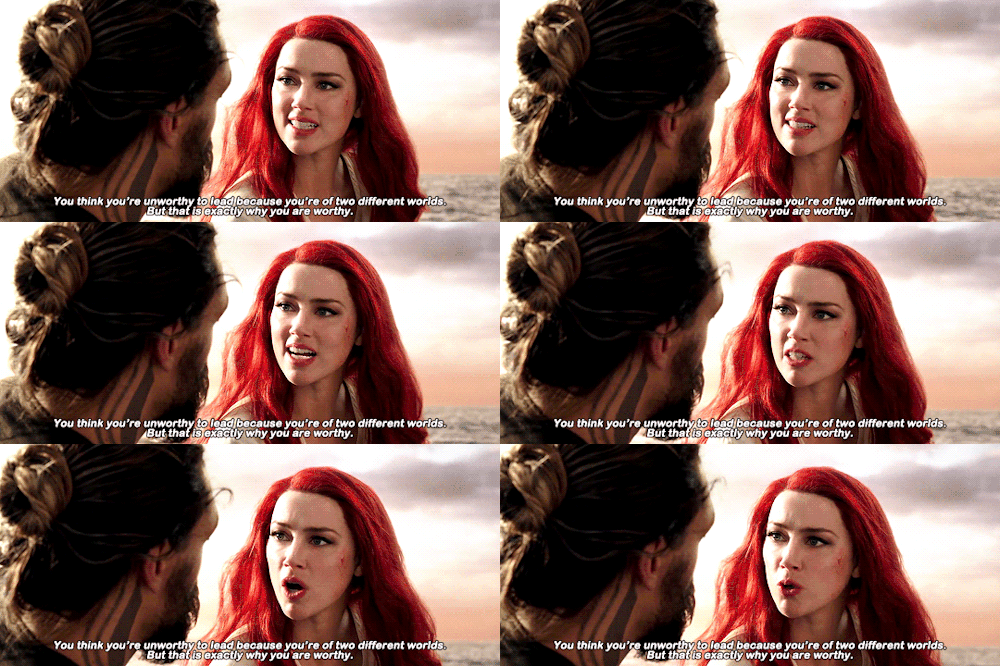
“Your half-brother, King Orm, is about to declare war upon the surface world. The only way to stop his war is for you to take your rightful place as King.”
-Mera

Growing up mixed (black/white) there were many white folks along the way who assured me of the post-racial fantasy: “everyone will look like you in fifty years,” or that “eventually everyone’s gonna fuck everyone else and we’ll all be some shade of brown.” I’ve heard a million variations of this sentiment from the young and old, all liberals. I even believed it myself for a number of years. I sort of wore the possibility of a mixed up future like a badge of pride. Like I made it to a lame party I knew would be bumping in a few hours. Even up to a few years ago I would get revved up about the multiracial possibilities ahead on the horizon the potential of multiracial men and women to be the bridge of understanding and unity between two races. Now it’s just frustrating. It’s cynicism masquerading as optimism. Just as the race relations in the world of Aquaman have reached a boiling point, so too have relations in our reality. Somehow this hasn’t produced an innovation in thought or problem-solving, rather we seem to cling all the stronger to the simplest solutions, the ones that let us feel good without exerting much thought or energy.

Image result for multiracial gif

Aquaman offers the same sort of racial catharsis that films like Green Book put forth. The antagonist is so backward and ignorant that they say egregious things like, “A half-breed mongrel dares to come and take the sacred relic of King Atlan?” providing a distinct image of ‘what a bigot looks like’ thus giving some audience members the sigh of relief, “That’s a bad person. That’s what a racist looks like?” The unspoken, yet understood sentiment is: Not Me.

NG
National Geographic: The Changing Face of America (2013)


My One Big Issue w/ Jump Force

Last month saw the release of the highly anticipated Jump Force, a fighting game ambitious enough to gather 30+ (playable) Shonen Jump All-Stars. I pre-ordered my copy and got to battling the day of the release. To my surprise, Jump Force was met with lukewarm reviews. It gets called out for its stiff character interactions and lack of coherent direction in the Story Mode. As a longtime fan of several Shonen Jump/Shuiesha titles, a major selling point for the game was getting Goku and Hisoka, or Gon and Yusuke, or Boruto and Luffy in the same place. To say their interactions leave something to be desired would be accurate. I can live with that though, my imagination is vivid and I can make up my own reasons for our heroes to duel.

The major, glaring flaw of Jump Force is the absence of playable female characters. There are three: Kaguya (Naruto: Shippuden, Rukia (Bleach), and Boa Hancock (One Piece). This means the men outnumber the women by a ratio of almost 10:1. Even with the list of DLC characters on the way, we see the addition of one more female character, Biscuit Krueger (Hunter X Hunter). Where’s Android 18 (Dragon Ball Z)? Sakura (Naruto)? Lisa Lisa (Jo Jo’s Bizarre Adventure)? Where’s Genkai (Yu Yu Hakusho)? WHERE’S GENKAI?!

Image result for jump force character

This was pretty much my issue with Yu Yu Hakusho: Poltergeist Report, the second theatrical film of the series. When the Spirit Realm is threatened by the reemergence of the Nether-Realm, a plane of existence which previously rested above the Demon Realm in the same way that the Spirit Realm rest above the Human Realm. This is all significant because the three gods of the Nether-Realm seek to co-opt our realm (the Human Realm) to remake their world. This of course means lots of death and destruction and carnage for humanity, starting with Tokyo. I rented an old U.S. Manga Corps. DVD so there was a quality drop from the remastered episodes on Hulu. Still, the film was entertaining. The events fall somewhere after the Dark Tournament and the Demon Realm arcs. Yusuke, Kuruma, Hiei, and Kuwabara have honed their fighting skills to extraordinary levels yet remain teenage boys in their emotional development. The animation really leaps in quality in the final fight producing some dazzling moments.

Related image

The film seems fine with leaving its female characters on the sidelines. Botan, the Spirit Realm messenger/Cute Reaper, is almost exclusively shown battered in the arms of a comrade, Yukina and Keiko appear briefly before being injured as well. There is a fight between Genkai and Yakumo is fun but concludes quickly and takes Genkai out of the game for the rest of the film. And Shizuru isn’t even present…

Image result for yu yu hakusho poltergeist report gif

Poltergeist Report is a microcosm of my qualm with Yu Yu Hakusho, in that it relegates the women to catalyst roles that serve mostly to advance the development of the boys. Keiko is presented early on in the series as a friend turned romantic interest for Yusuke, and while she stays that way for the duration of the show’s 112 episodes, her screen time is limited to scenes where she plays the nervous cheerleader in Yusuke’s quest. Initially, Keiko is a needed tether to the life Yusuke moves away from in his service to the Spirit Realm. Unlike Yusuke, she isn’t whisked away from the life of a teenage student. She still has to manage the everyday and the mundane while the boys go on distant adventures. Personally, I don’t see her character as integral to the series, BUT if she’s going to be present, you’ve got to do more with her than clench her knuckles every time Yusuke gets himself involved in danger.

Related image

Yukina is another missed opportunity. While she is the distant (and estranged) sister of Hiei, the two never have a moment to unpack this together. In fact, Yukina never discovers the truth even while several other characters do. Hiei decides not to tell her at the end of the series and within Poltergeist Report, Kuruma again asks why Hiei abstains from filling her in and is brushed off. Like Keiko, she is a spectator of several battles throughout the series though her actions are limited to nervous worrying.

Shizuru is a little different in that she uncovers latent clairvoyant abilities and is able to act as a medium in moments of otherworldly dangers. She’s written as mature, cool headed, stern yet compassionate, and always smoking (I know it’s bad for you but she looks so cool with a cigarette). Shizuru doesn’t fight but with her abilities she’s at least able to be more than another worried wreck.

Lastly, there’s Genkai or Ba-san (grandma). She is a wise mentor, a difficult teacher, a formidable fighter, and one of my favorite characters. When we first meet her, she falls into the old mentor role so common in shonen stories. She becomes so much more she fights alongside our heroes in the Dark Tournament. In fact, it is her history with the younger Toguro that forms the backbone of the arc and the motivation the team being there in the first place. Even after relinquishing her power to Yusuke for him to advance against Toguro, she’s still exceptionally formidable and able to tango with the baddest of fighters.

Image result for yu yu hakusho genkai gif

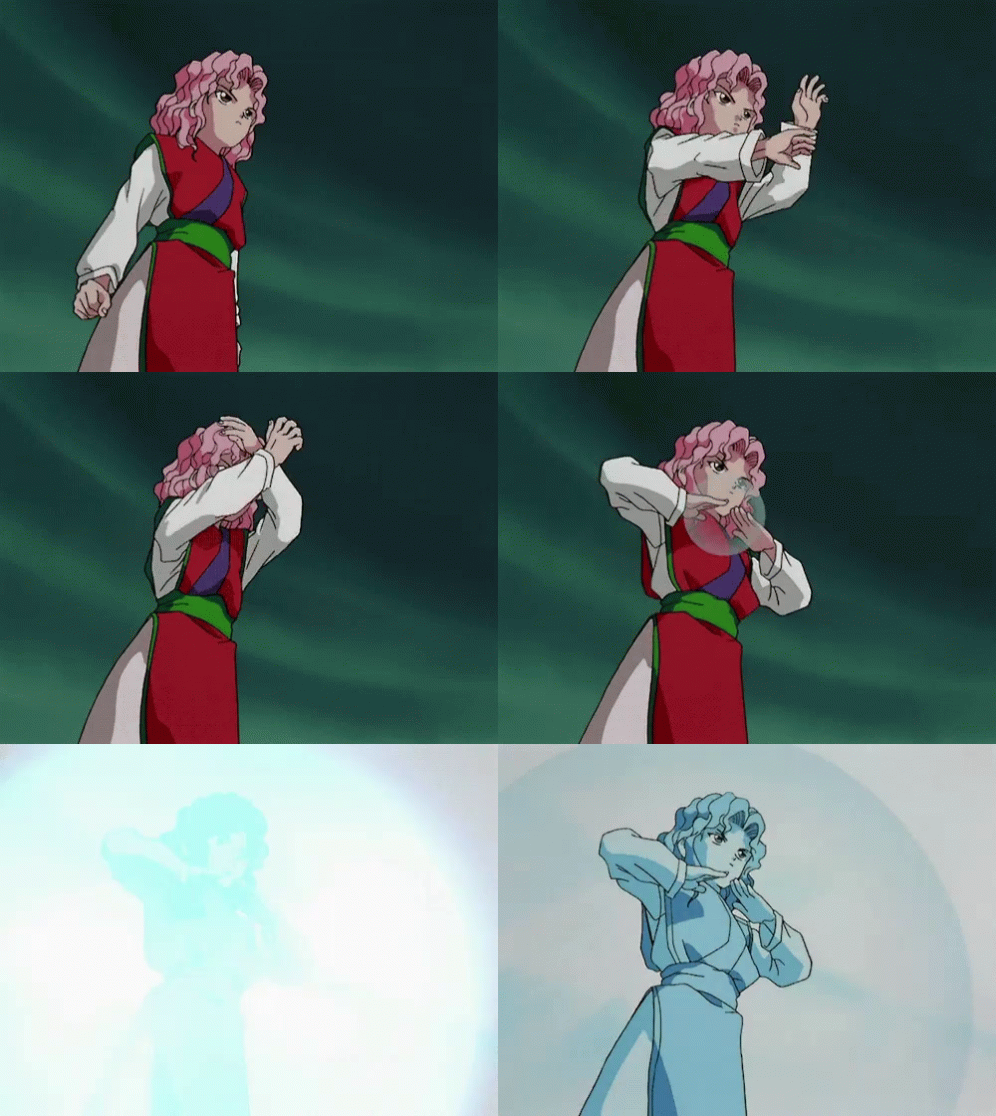
That’s why it was such a disappointment when Poltergeist takes her out after her first fight, and why it’s such a disappointment that we don’t see her among the Jump Force lineup. Have we forgotten who taught Yusuke the ‘shotgun’ a technique where one balls up their fist releasing a scattershot of rei beams? Who went toe to toe with the brothers Toguro?

Image result for yu yu hakusho genkai gif

Yu Yu Hakusho does so much right. It consistently shows us what positive male friendships and rivalries can look like, it honors the growth of a team over one (Goku-esque) hero who is usually the only hope of survival. It features a non-binary individual as a major character. The opening and ending themes have found their way into my regular rotation. Hell, I actually struggle to come up with characters I don’t like– usually it’s merely small facets of their character.

Obviously, I’m talking about a show nearly 30 years old at this point, so not a whole lot can come from my gripes but as we continue to see the release of new Shonen series like My Hero Acadamia that appeal to the same demographics and walk closely in the footsteps of Yu Yu Hakusho, it’s so imperative that we critique the ways in which the genre handles the women they present. Afterall, there are HELLA women that ride hard for all things Shonen. Just ask @blackgirlsanime!

https://www.instagram.com/p/BqihPojDs3p/

Bombed Out / Undeterred: Stromboli

Ingrid Bergman the name without a face I knew for years, and often confused with famed director Ingmar Bergman. I believe her roles in the films of Roberto Rossellini (watched recently) have been my first experiences with her work. Actually, as I type this, I’m remembering that I saw Casablanca over a decade ago, and to be honest, all I remember is that I enjoyed Humphrey Bogart’s performance. With that said, her performances in the Italian Neorealism classics ‘Journey To Italy’ and ‘Stromboli’ were immensely enjoyable. Let’s talk about the latter.

Image result for stromboli film gif

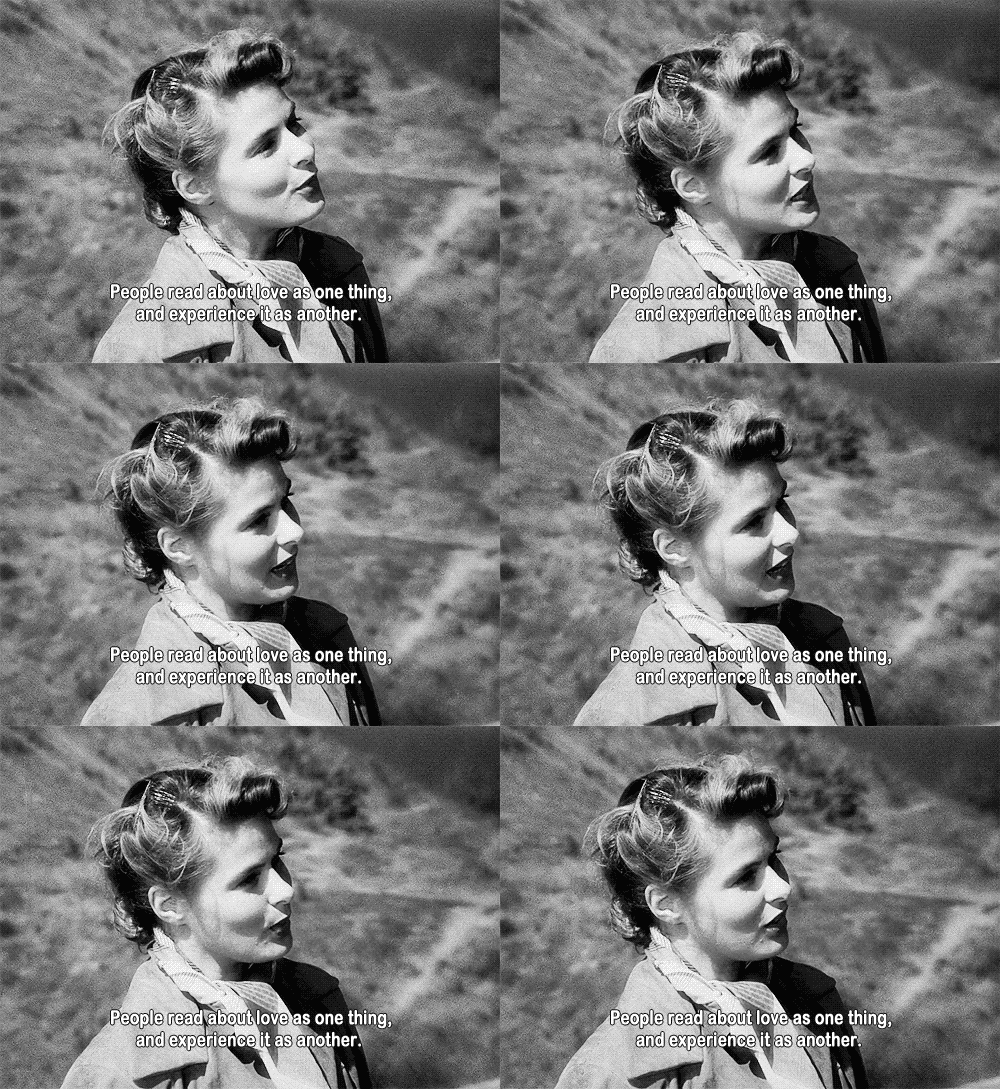
Stromboli opens with Karin (Bergman), a Lithuanian, in an interment camp. Charmed by Antonio (Mario Vitale) an Italian ex-POW fishermen who proposes to her with promises of returning to his home island of Stromboli to start a life together. Their marriage secures her release and together, they voyage to the island. Upon arrival, Karin is met with the harsh reality of life on the island. The year is 1944 and throughout the preceding decade many of the island’s inhabitants have migrated elsewhere, seemingly leaving only the most staunchly conservative residents on the island. Much of the structures, including Antonio’s previous home, are in disarray and in need of serious renovation. And to add to all this, the two have only a few dozen lire between them.

STR 2

Initially distressed and dismayed at her new life, Karin turns to an island priest with experience of the world outside of Stromboli, as a source of support. In time, Karin comes to embrace her surroundings. She renovates Antonio’s childhood home, attempts to make friends of her own, and regularly confers with the priest on marriage advice. Unfortunately, the island and its inhabitants are as resistant to her as she is to them. Many of the island women, especially the clergy, view Karin with disdain for her “lack of modesty.” They view her attempts remodeling her living room by painting floral displays and her friendliness with any male not her husband as an affront to their ways.

Image result for stromboli film gif

The story is told through the eyes of Karin, though we are often asked to reflect on Antonio’s dismay. Unlike Karin who was shuffled from camp to camp across Europe during the second world war, Antonio has only ever left the island to fight in the war. He is simple and young with no worldly desires. He settles back into the humble life of a fisherman immediately after his return. While courting Karin, he tells her that he knows what kind of woman she is, that he understands her. In the moment, this feels like the sweet naivety audiences are accustomed to in romantic pictures. These two have survived the largest war of the century, surely a happy marriage is attainable. The assumption may be damning. Antonio receives Karin’s woes and financial worries as a mark on his home and heritage. It is clear that Karin’s struggle to assimilate distresses him, though he struggles to understand why.

The second and third act feature extended scenes of animal struggle meant to mirror the hopelessness and disconnect in Karin and Antonio’s marriage. First, we see Antonio bring home a pet ferret in the hopes of using it to catch game like rabbits. Joyfully, he displays the ferret’s hunting prowess with a live rabbit. Karin looks on in horror at the helplessness of the rabbit, seeing something of herself in the creature’s plight, while Antonio cackles in delight. This scene, along with the big fishing haul near the film’s climax, serve to highlight the chasm between the lovers. Antonio celebrates the haul as it will not only feed the village, they can sell the excess fish on the mainland to support the village. Karin, again, sees herself in the fish’s plight.

Image result for stromboli film gif

Events escalate when Karin confirms she’s three months pregnant just hours before the island’s volcano erupts. The island inhabitants quickly rush to the boats and take to the sea for protection. Eventually, Karin and Antonio return to the island, though Karin has made up her mind. She tells Antonio that she can no longer bare life on the island, she is returning to the mainland. The film climaxes with Karin attempting to cross the island. Choosing to go up and over, she reaches the peak, stares down into the magma pit, and passes out in a fit of despair. She awakens with new resolve, vowing to God not to be defeated as she puts a hand to her belly. But by who? The island? Life?

Bergman’s performance was by far the most enjoyable part of this film. The fishing scene is extraordinary in that it is shot documentary style– those are real citizens of Stromboli and real fisherman. In fact, as per Neorealist style, most of the island’s inhabitants are not professional actors. The shot of the volcano’s eruption are dazzling and terrifying. Unfortunately, much of this movie dragged. While we understand the distance and aversion of the islands inhabitants have to Karin, we never get to know them. Rossellini writes them off quicker than Karin can. Also, Karin’s direction at the end of the film is vague.

3/5